© Copyright 2005 - 2016 All Rights Reserved


SENIOR GUINEA PIG CARE
Guinea pigs can suffer from conditions such as arthritis, eye sight issues and can lose muscle and body mass as they progress in age. The average life span of a
guinea pig is 5 to 7 years. Some guinea pigs can live till 9 or 10 years. The official record for the oldest guinea pig is 14 years and 10 and a half months. Guinea
pigs can be considered to enter their “senior” years at around 4 to 5 years of age, or when symptoms of age develop.
The key to ensuring your guinea pig maintains a healthy and good quality of life is to be vigilant in obtaining prompt medical assistance at the first signs of illness,
weighing your guinea pig on a weekly if not daily basis, and being aware of the first signs of illness.
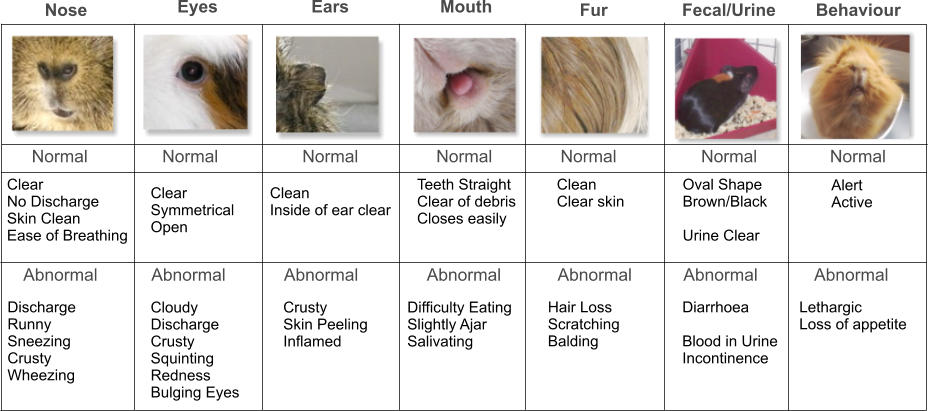
Guinea pig Health chart below indicates common symptoms of Illness in Guinea pigs
Arthritis In Guinea Pigs
Guinea pigs like humans can develops arthritic symptoms:
"Guinea pigs spontaneously develop arthritis that bears morphological, biochemical, and immunohistochemical similarities to human osteoarthritis. It is
characterized by the appearance of superficial fibrillation by 12 months of age and severe cartilage lesions andeburnation by 18 months of age."
Modification of osteoarthritis by pulsed electromagnetic field —a morphological study D. McK. Ciombor Ph.D.†, R. K. Aaron M.D.*, S. Wang M.D.† and B. Simon
Ph.D.‡†Department of Orthopaedics, Brown Medical School, Providence, RI 02906, USA ‡EBI, Parsippany, NJ 07054, USA OsteoArthritis and Cartilage (2003) 11, 455–462 ©
2003 Published by Elsevier Science Ltd on behalf of OsteoArthritis Research Society International.
Arthritis can not only effect senior guinea pigs but cavies from 12 months onwards. Arthritis is often exhibited by a stiffness, inability to move or be as agile as they
once were, or they are hesitant in running, begging for food or doing exercise they normally would do.
X-Rays can be extremely helpful in identifying which areas your guinea pig is suffering from arthritic pain. An x-ray will usually show a lump/swelling around a
bone or joint where the arthritis is present.
Your exotics veterinarian can help formulate a long term plan to help manage day to day pain for your guinea pig, making their life easier. Many owners find
increasing the levels of vitamin C in the diet can assist with inflammation often associated with arthritis. Vitamin C can be given in a chewable vitamin supplement
in addition to vegetables high in vitamin C such as capsicum, coriander and tomatoes. Oxbow chewable vitamin C for small animals is recommended when
choosing a supplement for your guinea pig.
There are other treatments to combat arthritis which you can discuss with your exotics veterinarian. These include: Metacam, Meloxicam, Glucosamine and
Cosequin medications to assist with pain relief and inflammation. Unfortunately there is no cure for arthritis so pain management is crucial to ensure your senior
guinea pig remains healthy and happy.
Tips to Maintaining a Good Quality of Life:
Ensuring your guinea pig is not only healthy but comfortable in their senior years will help ensure they have a good quality of life. Below are a few ideas to help
keep your guinea pig comfortable, happy and pain free:
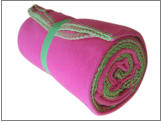
Fleece bedding: Senior guinea pigs can develops arthritic symptoms and may find it easier to walk on a softer surface. Polar fleece
bedding offers a soft, easy and comfortable walking platform to allow ease of movement. Choosing a lighter colour fleece can also help
monitor your guinea pigs urine and fecal output to monitor signs of illness. For more information on fleece as a bedding option click
here.
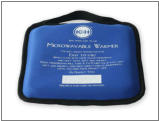
Heat pads: Guinea pigs may find heat pads and wraps helpful to alleviate pain and aching joints. Heat pads can be warmed in the
microwave and can be purchased at pharmacies, medical supply stores or some retailers such as Big W, and K-Mart. Please ensure that
any heat pads you place in your guinea pigs cage they can easily walk away from if the heat become excessive. All pads must be 100%
securely wrapped with a towel or blanket. Never expose your animals to any dangerous sources of heat.
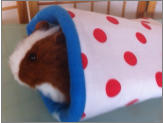
Polar Fleece Pouches/beds/tunnels: Guinea pigs love tunnelling and enjoy a safe, warm place to snuggle up. A piggy pouch or similar
item is perfect to allow your cavy to rest, re cooperate and have a safe, comfortable place to have a snooze. They offer a perfect haven
for warmth and are always recommended as a great cage accessory. Guinea Pigs Australia now offers hand made snuggle sacks with
cosy fleece bedding to purchase. See snuggle sacks for more information.
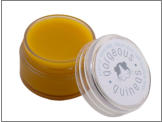
Perfect Paws Ointment: Senior guinea pigs may develop or be prone to dry cracked skin especially on the soft pads of their feet. They
may find it harder to groom themselves so you may need to invest in a safe ointment to use on guinea pigs to ensure their feet are well
moisturised daily. The gorgeous guineas range offers an ointment called Perfect Paws which helps assist in dry, cracked paws designed
specifically for guinea pigs. Aloe-Vera soothe gels, foot and mouth ointments and kwench lotion is also available to help care for your
guinea pigs skin, fur, and feet. See the Gorgeous guineas range of products here.
Grooming: Some guinea pigs as time goes on may find it difficult to groom and care for themselves without assistance. You may need
to check your guinea pigs bottom daily and clean away any excess urine or fecal matter. Gently using warm water your can wipe away
any urine or fecal matter and towel dry. Always ensure your guinea pig is completely dry prior to placing back in its cage. Trimming
your guinea pigs fur may be necessary to avoid urine from soaking into the fur and skin. Always check your guinea pig daily, and look
at their paws, eyes, ears, nails, teeth and skin. Keep your guinea pig clean by grooming them on a daily basis and always ensure their
cage is kept clean. See cage cleaning for more information and our Bathing Guide.
Weight: Weight is vitally important for pigs of all ages. Guinea pigs are prey animals and may be able to hide or cover any outward
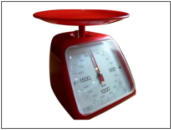
signs of illness. Weigh your guinea pig on a weekly basis. Weight loss is one of the first signs of illness. Invest in a good set of digital
scales and record your guinea pigs weight. Guinea pigs with a past history of illness and weight loss, should be considered for daily
weighing. See our weight information page for more information.
Malocclusion and teeth issues:
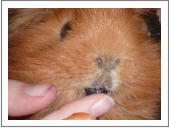
Malocclusion in guinea pigs is when the lower cheek teeth grow towards each other and essentially "trap" the tongue so it is difficult to
move causing starvation and weight loss. The front incisors can also continue to grow as the teeth are not wearing down at a normal rate.
Elongation of the cheek teeth can also cause the mouth to stay open which is known to cause the masticatory muscles or chewing
muscles to essentially stretch and the mouth cannot close. There are many causes why guinea pigs can develop malocclusion as it can
develop at any age. It can be genetic, a lack of fibre in the diet in the form of grass hay, infections, trauma, jaw disease and bone disease.
Some veterinarians also consider Temporomandibular joint disorder or TMJ a cause especially in senior pigs as the joint may wear down
over time and become weakened essentially allowing the teeth to overgrow.
Always check your guinea pigs teeth on a daily basis, watch for signs of teeth issues - these could range from not picking or eating food as
they usually do, drooling, excessive movement when chewing, eye or nose discharge, weight loss or your guinea pig has an appetite yet
cannot eat.
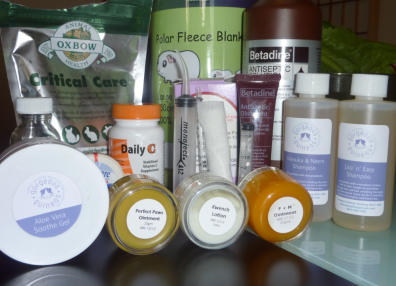
Medical First Aid Kit
A great way to assist and care for your senior pig is investing in a first aid kit. Guinea pigs can go
downhill quite quickly and when urgent medical assistance cannot be sought it may be necessary to
assist feed or care for your guinea pig. Some essential items below should be kept in an emergency
situation:
Oxbow Critical Care TM: Critical care is an assist feeding formula for herbivores. It contains many
of the essential vitamins, minerals and fibre required when a guinea pig cannot eat or has difficulty
in eating. A guinea pig MUST have constant access to food and water. Food is life.
Syringes: Every first aid kit should have a 1 ml syringe. They can assist with dispensing medicine,
hand feeding critical care, fluids and also flushing wounds. They can be purchased at pharmacies
and veterinary surgeries. It may be a good idea to also purchase a cannula syringe for flushing
abscesses and a 3 ml syringe for thicker critical care assist feeds.
Bedadine Solution: A great antiseptic treatment,solutions are 10% povidone-iodine in water.
Bedadine can help prevent infection in open wounds and can assist in keeping wounds and sores
clean.
Foot and Mouth Ointment: Is an all natural ointment which has been known to improve cases of Bumblefoot in guinea pigs. Ointment for guineas with skin
problems on their feet and mouth. Can assist with mouth sores, scabs, and Bumblefoot. For more information on Foot and Mouth Ointment Click Here
Perfect Paws Ointment: A soothing ointment that can be used on cracked, dry or sore feet. Great for Senior Pigs and those winter months. This ointment is
designed to help piggies with sore feet. Hard or cracked skin. For more information on perfect paws ointment click here
Aloe Vera Gel - A plain gel made from an Organic Aloe Vera Gel Base. No essential oils, so safe to use on pregnant sows. It is soothing, cooling and can help to
reduce heat and redness in the skin. The one "must-have" product for your First Aid Kit. For more information on Aloe-Vera Gel click here.
Kwench Lotion: Kwench Lotion has been designed for use in-between MicroNeem baths / Melts to help with Fungal skin problems including Ringworm. It is
particularly effective around sensitive areas on the face, in particular area around the ears and eyes. A small amount is applied 2-3 times a day and rubbed gently
into the skin. This lotion is light, non-greasy and easily absorbed by the skin. For more information on Kewnch Lotion click here.
Vitamin C Tablets: Chewable vitamin C tablets can give an ill guinea pig a boost of much needed vitamin C an essential daily supplement. It is always a great idea
to have a bottle in the cupboard in case of an emergency. Guinea Pigs Australia recommend Daily C by Oxbow TM.
Bandages: For wrapping and covering wounds. Do not use sharp items to hold the bandage in place- a soft tape may be more efficient.
HOME
ABOUT US
CONTACT US
MEDIA
BOARDING